The Perfect 2 Days in Quebec City (Local Itinerary)
If you have 2 days in Quebec City, you have enough time to explore Old Quebec, visit Montmorency Falls and experience a little of the countryside surrounding the city without racing from one attraction to the next.
I live in Quebec City, and I designed this itinerary to follow a logical route. Day one takes you through Upper and Lower Town before ending on the St. Lawrence River, while day two combines Montmorency Falls with a few carefully selected stops on Île d’Orléans.
You’ll see the landmarks Quebec City is known for, but you’ll also have time to wander, enjoy the river views and experience the atmosphere that makes the city special.
This post contains affiliate links. If you make a booking or purchase through one of these links, I may earn a small commission at no additional cost to you. Your support helps me continue creating honest, firsthand travel guides—thank you! Read my full affiliate disclosure for more information.
How to Spend 2 Days in Quebec City
Here is a quick overview of this 2-day Quebec City itinerary:
Day 1: Old Quebec and the Lévis Ferry
- Parliament Building and Fontaine de Tourny
- Saint-Louis Gate and Rue Saint-Louis
- Château Frontenac and Terrasse Dufferin
- Rue du Trésor
- Breakneck Steps
- Quartier Petit-Champlain
- Place Royale and the Old Port
- Québec–Lévis ferry
- Dinner in Old Quebec
Day 2: Montmorency Falls and Île d’Orléans
- Montmorency Falls
- Ferme Audet, Île d’Orléans
- Lunch and local food stops
- Sainte-Pétronille
- Plains of Abraham or Montcalm
- Dinner near Rue Cartier
Having a car makes the second day much easier. If you’re visiting without one, I’ve included an alternative that combines Montmorency Falls with more time in Quebec City.
Day 1: Old Quebec and the Lévis Ferry
Your first day is devoted to Old Quebec, including both Upper and Lower Town. The route is walkable, but expect cobblestones, hills and several staircases.
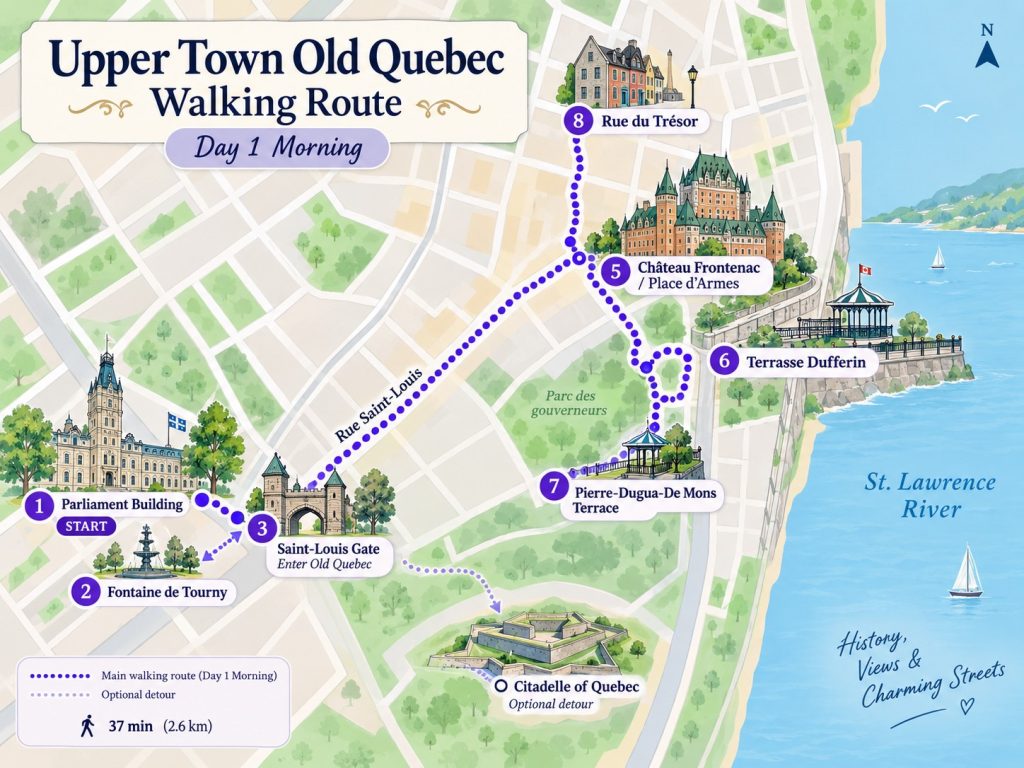
Follow this Day 1 morning walking route through Upper Town Old Quebec, including Château Frontenac, Terrasse Dufferin and the historic streets inside the fortifications.
Morning – Start at the Parliament Building
Begin outside the walls of Old Quebec at the Parliament Building, home of Quebec’s National Assembly. Even if you don’t take a guided tour, it is worth walking around the exterior and seeing the statues built into its facade.
Directly in front is the Fontaine de Tourny. The fountain and surrounding gardens are particularly beautiful from late spring through fall.
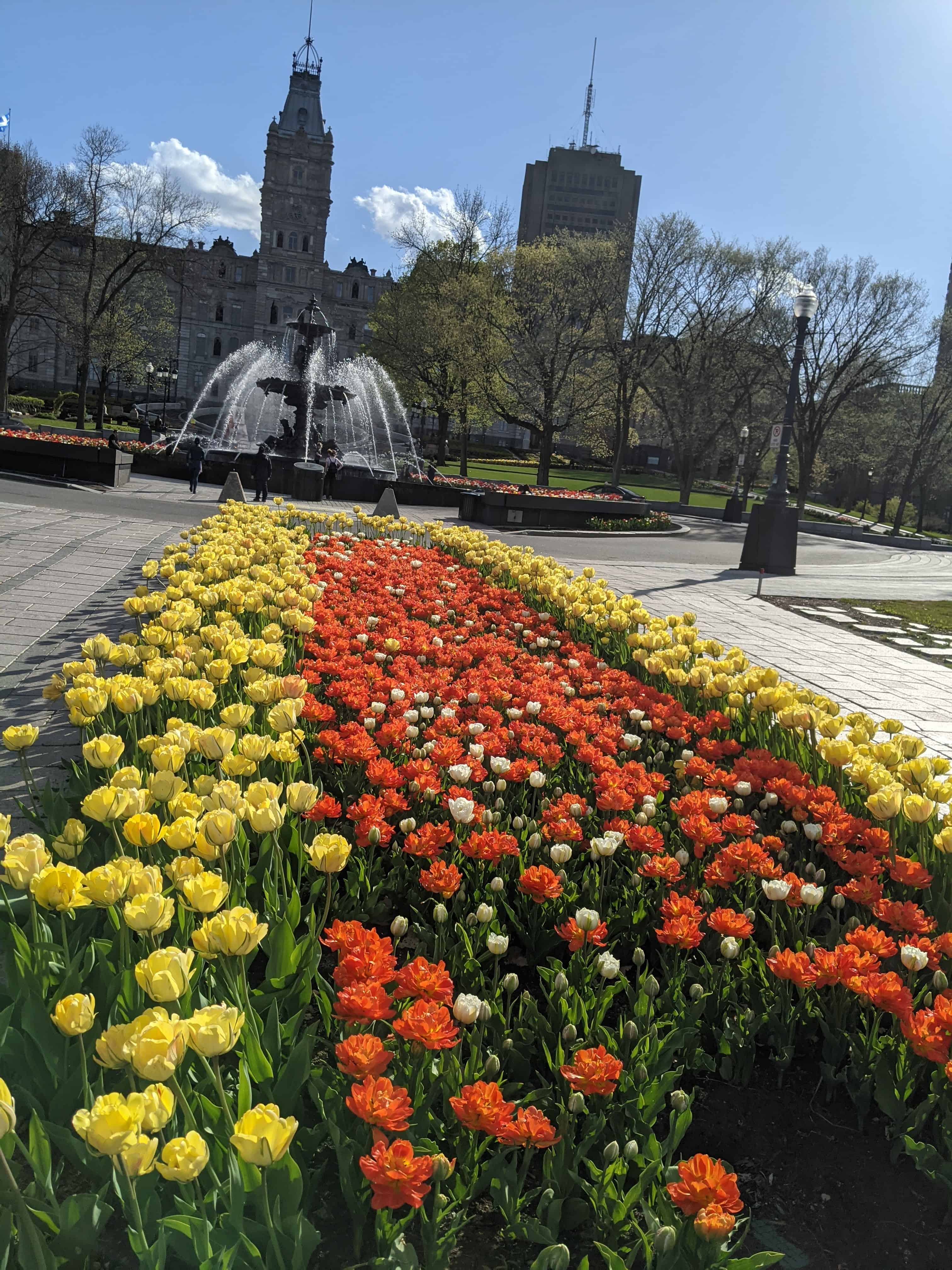
Spring tulips frame the Fontaine de Tourny, with Quebec’s Parliament Building rising behind it, one of the prettiest approaches to Old Quebec.
From here, walk toward Saint-Louis Gate. Passing through one of the historic gates is the perfect way to begin your first morning in Old Quebec.
Walk Along Rue Saint-Louis
Continue through the gate onto Rue Saint-Louis, one of the main streets inside the fortifications. You’ll pass historic stone buildings, restaurants and smaller streets leading deeper into Old Quebec.
If you’re especially interested in military history, you could detour toward the Citadelle of Quebec. A proper guided visit takes time, though, so I would choose between touring the Citadelle and completing the entire itinerary rather than trying to squeeze in both.
For this two-day visit, admire the fortifications and continue toward Château Frontenac. You can save the Citadelle for a longer trip.
Château Frontenac and Terrasse Dufferin
At the end of Rue Saint-Louis, you’ll reach Place d’Armes and the Fairmont Le Château Frontenac. It may look like a castle, but Château Frontenac was built as a hotel and remains one today.
Walk through the public areas of the lobby, then continue onto Terrasse Dufferin. The boardwalk has wide views over the St. Lawrence River, Lower Town and Lévis on the opposite shore.

Looking toward Château Frontenac from Terrasse Dufferin, one of the most iconic walks in Old Quebec.

One of my favourite viewpoints in Old Quebec, overlooking the St. Lawrence River from Pierre-Dugua-De Mons Terrace.
For one of my favourite views, climb toward Pierre-Dugua-De Mons Terrace. The angle over the rooftops, river and Château Frontenac is worth the short uphill walk.
In winter, Terrasse Dufferin is also home to the historic toboggan slide. It is an easy seasonal experience to add without changing the rest of your day.
Rue du Trésor and Upper Town
Before heading into Lower Town, walk through Rue du Trésor, a narrow pedestrian alley where local artists display their work.

Local artwork displayed along Rue du Trésor, a pedestrian art alley in Old Quebec.

Continue your Day 1 itinerary through Lower Town Old Quebec, from the Breakneck Steps and Petit-Champlain to Place Royale, the Old Port and the Québec–Lévis Ferry.
Afternoon – Descend Into Petit-Champlain
Return toward Terrasse Dufferin and descend using the Breakneck Steps, known locally as the Escalier Casse-Cou. From the staircase, you’ll get one of the classic views over Rue du Petit-Champlain.
If steep stairs are difficult for you, take the Old Quebec Funicular instead. Otherwise, I recommend walking down and saving the funicular for the climb back up later.

The view over Rue du Petit-Champlain from the Breakneck Steps.
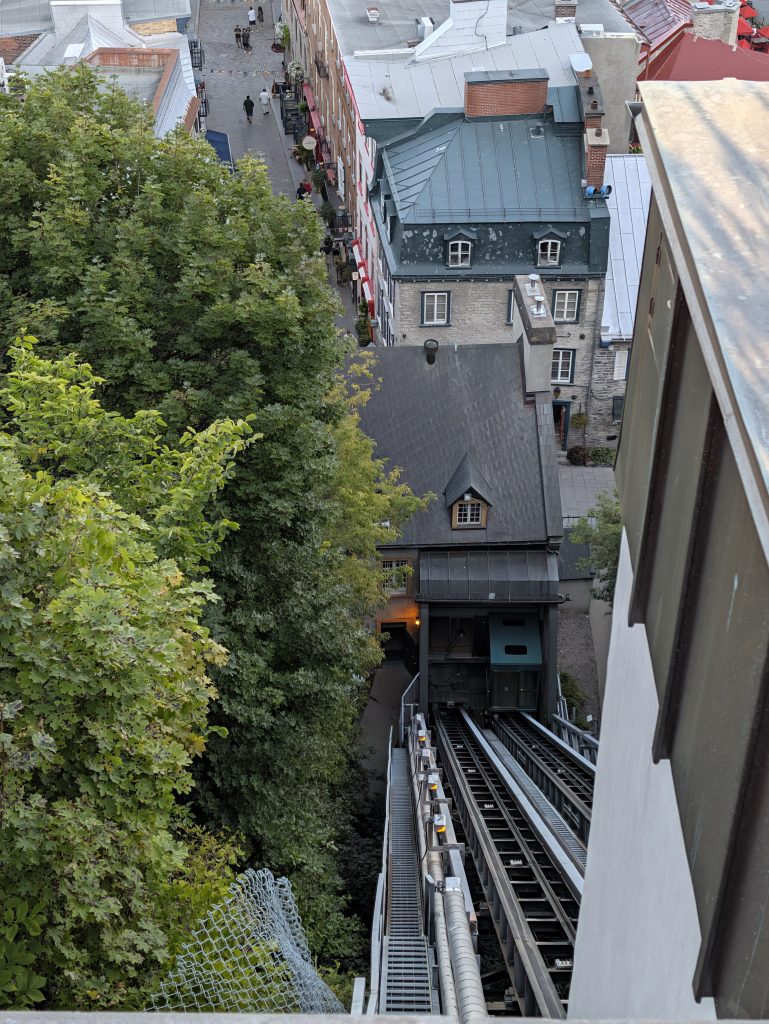
The funicular connects Upper Town with the Petit-Champlain district below.
Once you reach the bottom, take your time along Rue du Petit-Champlain. It is one of the most photographed streets in Quebec City, but it is also filled with independent boutiques, galleries, cafes and restaurants.
Lunch in Lower Town
Petit-Champlain is a convenient place to stop for lunch. You can choose a sit-down restaurant or keep it simple with soup, a sandwich or a pastry from a cafe.
Make a reservation if you have a particular restaurant in mind. Patios and small dining rooms fill quickly during summer, fall weekends and the Christmas market season.
Explore Place Royale
After lunch, walk to Place Royale, where Samuel de Champlain established a permanent French settlement in 1608. The compact square is surrounded by stone buildings and feels different from the busier streets of Upper Town.
One of my favourite things to do here is sit on the Maison Smith terrace with a coffee and watch people pass through the square. It’s an easy place to slow down for a while and take in the atmosphere of Place Royale.
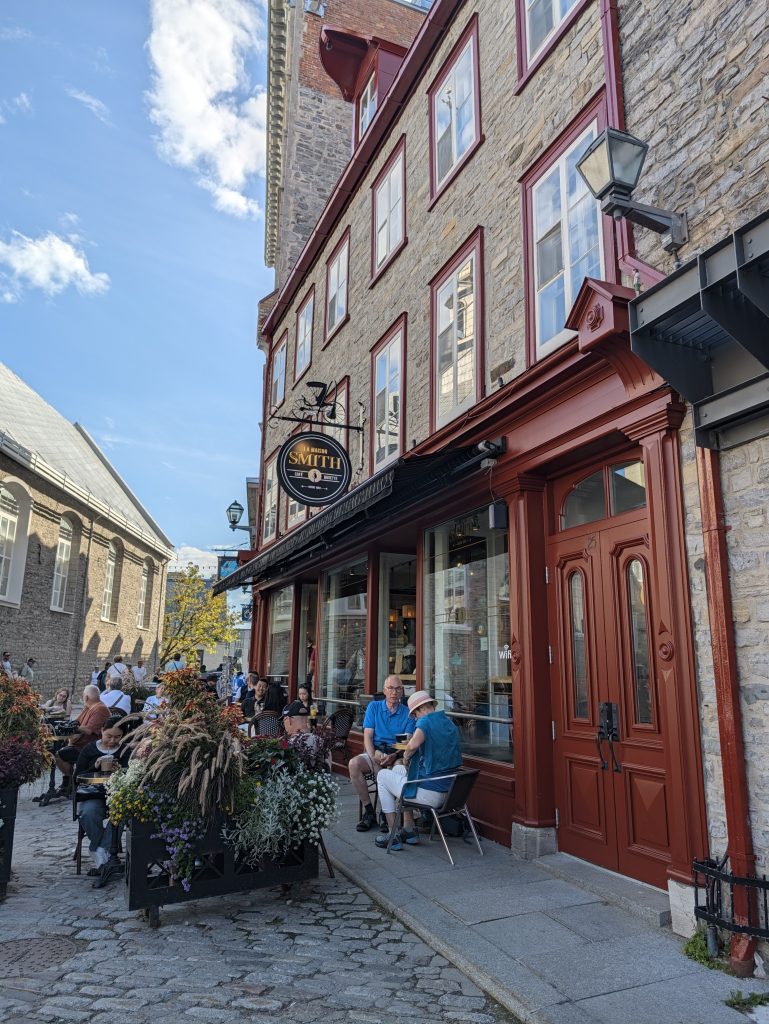
My favourite place to sit with a coffee and watch Place Royale go by.

Historic stone buildings and patios in the heart of Place Royale.
Step inside Notre-Dame-des-Victoires Church if it is open, then look for the outline marking the location of Champlain’s former habitation.
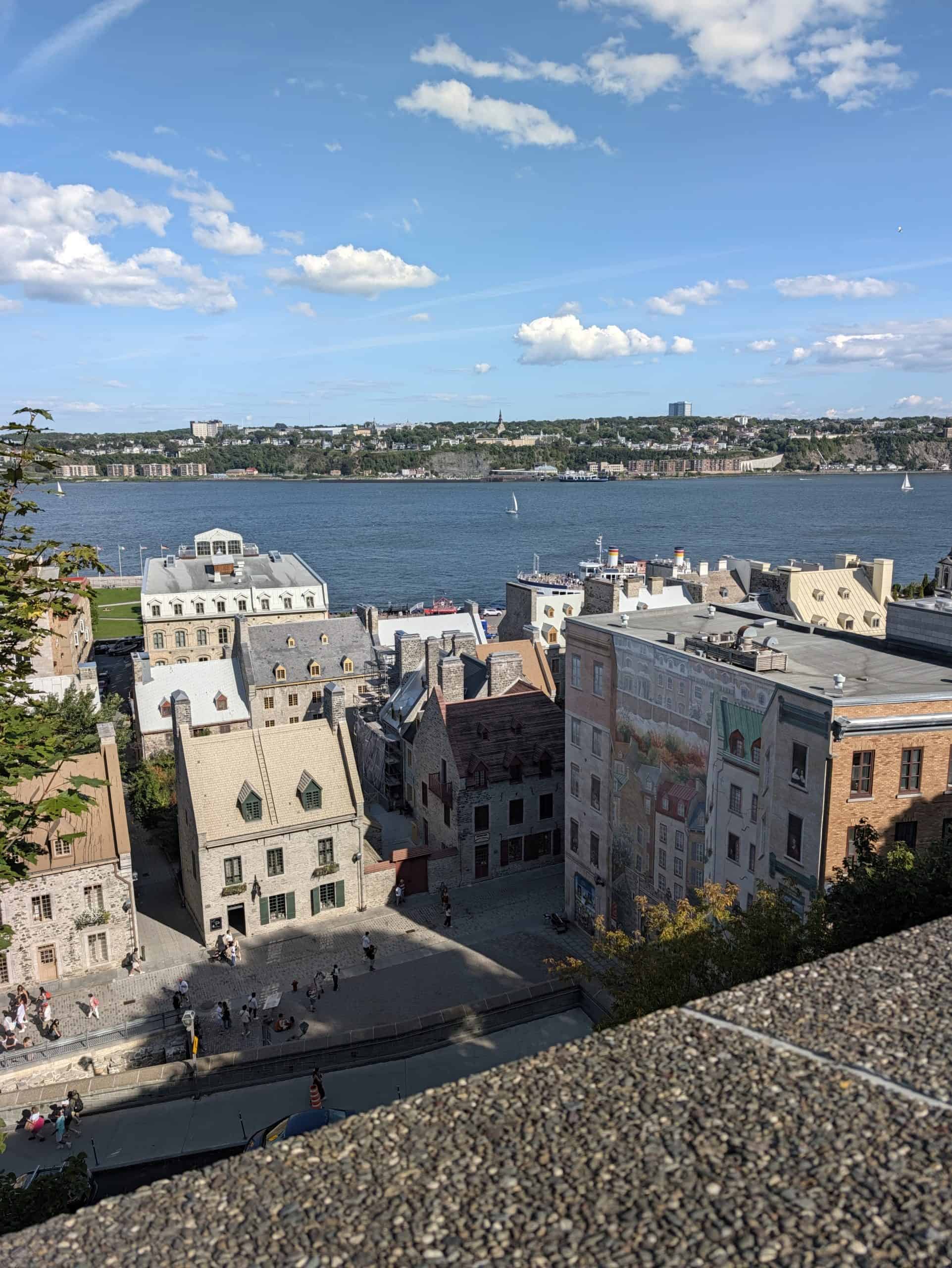
Just beyond the square, you’ll find the large Fresque des Québécois, which illustrates people and moments from Quebec City’s history.
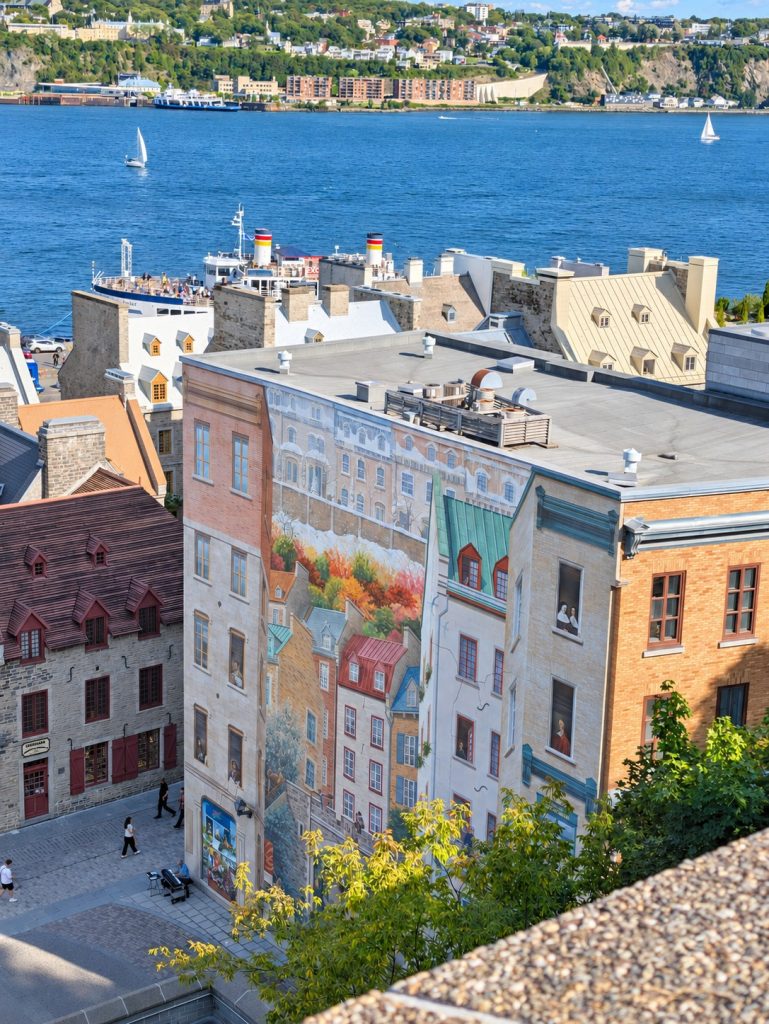
The Fresque des Québécois, with the St. Lawrence River and Lévis in the background.
Walk Through the Old Port
Continue toward the waterfront and the Old Port. Walk through Place des Canotiers, follow Rue Saint-Paul and browse the galleries, antique shops and smaller surrounding streets.
The Old Port feels calmer than the busiest parts of Old Quebec despite being only a short walk away. If the weather turns, the Musée de la civilisation is a good alternative and can easily fill the rest of your afternoon.
For additional ideas, see my guide to the 25 best things to do in Quebec City.
Take the Ferry to Lévis
End the afternoon with the Québec–Lévis ferry. The terminal is beside Lower Town, making it a natural final stop rather than a separate trip across the city.
The crossing takes approximately 12 minutes and offers one of the best complete views of Quebec City, including Château Frontenac, Cap Diamant and the fortifications.
Walk off the ferry and spend a little time at Quai Paquet. You don’t need to explore very far, the main reason for crossing is the view back toward Quebec City.
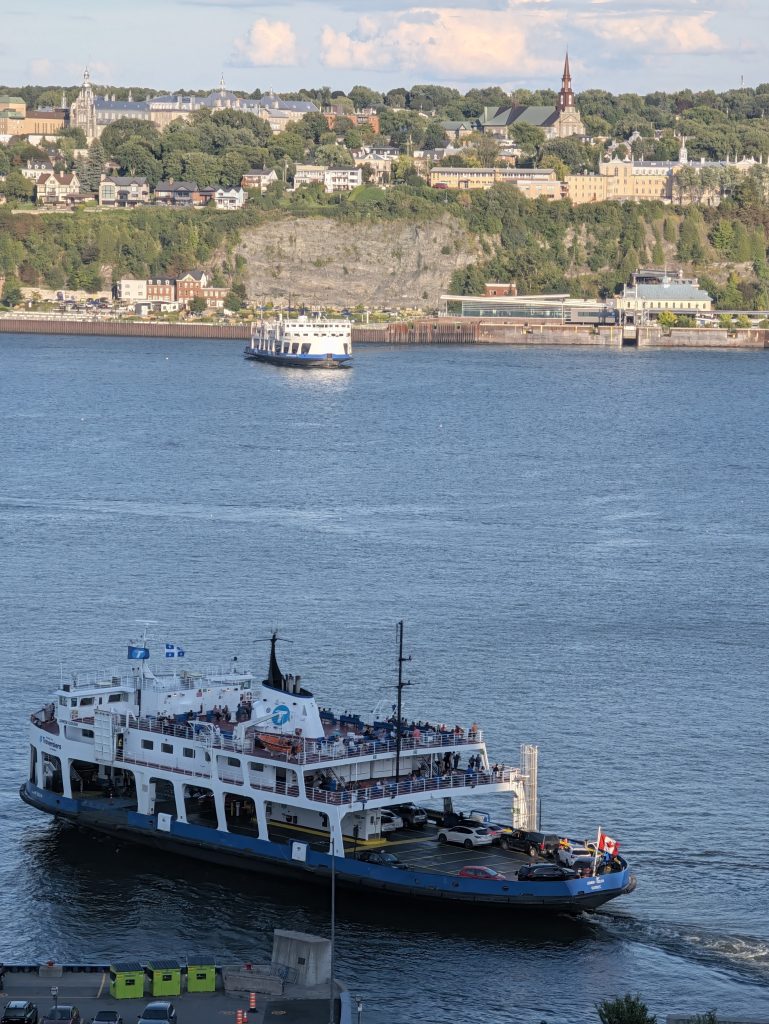
Try to time your trip near sunset, but check the official ferry schedule first. Sunset happens very early in winter and quite late around the beginning of summer.
Dinner in Old Quebec
Take the ferry back and finish your day with dinner. You can stay in Lower Town or ride the funicular back to Terrasse Dufferin and choose a restaurant in Upper Town.
After dinner, walk past Château Frontenac again. Old Quebec feels different once the day-trip crowds leave and the buildings are illuminated.
You’ve covered plenty of ground, so this isn’t the night to add another formal attraction. Slow down, order dessert or have a drink and let the city be the experience.
Day 2: Montmorency Falls and Île d’Orléans
Day two takes you just outside Quebec City. Montmorency Falls and Île d’Orléans are in the same direction, making them easy to combine when you have a car.
This route is best from late spring through fall, when more of the island’s farm stands, patios and seasonal businesses are open.

Day 2 driving route from Quebec City to Montmorency Falls and Île d’Orléans, combining waterfalls, local flavours, countryside and St. Lawrence River views.
Morning – Drive to Montmorency Falls
Leave early and drive to Parc de la Chute-Montmorency, approximately 15 minutes from Old Quebec without heavy traffic.
The waterfall is 83 metres high and can be viewed from several levels. Start near the base for the full view, then take the cable car or drive to the upper section and walk across the suspension bridge above the falls.
The panoramic route also includes a 487-step staircase. You do not need to climb every stair to appreciate the park, so choose the route that works for your mobility, available time and the weather. Allow approximately 1.5 to 2 hours. The outdoor site is accessible year-round, but services vary by season, so check the official Montmorency Falls information before visiting.
Afternoon – Cross Onto Île d’Orléans
From Montmorency Falls, continue across the bridge to Île d’Orléans. The island is larger than it first appears, and its villages, farms and viewpoints are spread along the road circling it. The trap is trying to stop everywhere.
You only have part of a day, so choose three or four places. I would prioritize a mix of local food, countryside and river views instead of driving the entire loop just to say you completed it.
My Île d’Orléans day trip itinerary will help you choose your stops, with a full-day route and a shorter option if you’re combining the island with Montmorency Falls.
Stop at Fromagerie Ferme Audet
Continue toward Saint-François and stop at Fromagerie Ferme Audet, where the artisanal products are made with goat’s milk from the farm’s own herd.

Taste a few of their cheeses, pick up your favourite for later and don’t leave without trying the goat’s milk ice cream. It’s a delicious way to experience the local flavours of Île d’Orléans while supporting a small island producer.
Stop for Lunch and Local Flavours
Depending on the season, you may find strawberries, apples, blackcurrant products, maple treats, cheese, wine, cider and fresh bread around the island.
Choose lunch based on what is open during your visit. A winery patio, seasonal restaurant or picnic made from farm-stand purchases fits this itinerary better than a long formal meal.
Popular options include Cassis Monna & Filles, Vignoble Ste-Pétronille and the island’s small bakeries and farm stands.
Explore Sainte-Pétronille
Finish in Sainte-Pétronille, at the western end of Île d’Orléans. Start by browsing Galerie-Boutique Pétronille for a locally made souvenir—it’s a much more meaningful place to find something from the island than the typical souvenir shops in Old Quebec.
Continue to the Chocolaterie de l’Île d’Orléans, then walk along Rue Horatio-Walker for views across the river toward Quebec City.
This area is beautiful around sunset, but I wouldn’t wait until evening during a two-day trip unless you plan to skip the final stops in the city.
Evening – Return to Quebec City
Drive back and decide how much energy you have left. For one final historic stop, walk through the Plains of Abraham and enjoy the views over the St. Lawrence River. For a more local atmosphere, head into Montcalm and walk along Rue Cartier.
Rue Cartier has restaurants, cafes and shops but feels more residential than Old Quebec. It is a good place to finish your trip with dinner away from the busiest tourist streets.
Day 2 Alternative Without a Car
You don’t need a car for the first day. Île d’Orléans, however, is difficult to explore without one because there is no regular public transportation connecting its main visitor stops.
If you’re travelling without a car, visit Montmorency Falls by bus or organized tour, then spend the afternoon in Quebec City.
RTC Métrobus 800 travels toward Terminus Chute-Montmorency. Check the current route using the RTC trip-planning tools, start early and allow most of the morning.
After returning, have lunch and walk through the Plains of Abraham before continuing into Montcalm and Rue Cartier.
If the weather is poor, replace the park with the Musée national des beaux-arts du Québec or the Musée de la civilisation.
Is Two Days in Quebec City Enough?
Yes, two days is enough for a first visit if you plan your route carefully. You can explore Upper and Lower Town, take the ferry across the St. Lawrence River and visit Montmorency Falls.
With a car and an early start, you can also experience part of Île d’Orléans. You won’t see the entire city or island, but you’ll leave with a better sense of the region than you would get from staying exclusively inside Old Quebec.
Three days would allow you to add a museum, spend longer on Île d’Orléans or explore neighbourhoods such as Limoilou, Saint-Roch and Montcalm more slowly.
If you’re staying longer and want to explore beyond the city, my guide to the best day trips from Quebec City will help you choose between mountain scenery, small villages and more time beside the St. Lawrence.
Where to Stay in Quebec City
For a short trip, I recommend staying in Old Quebec or immediately outside the fortifications. You’ll be able to explore early in the morning and after dinner, when the streets are quieter.
Fairmont Le Château Frontenac is best for an iconic splurge and river views. Monsieur Jean offers a stylish boutique experience between Upper Town and the Old Port, while Le Monastère des Augustines is a quieter, wellness-focused option in a historic setting.
You may find lower prices in Saint-Roch, Montcalm or Lévis, but those areas add transportation time. With only two days, I would prioritize location unless the savings are significant. If you arrive by car, check hotel parking rates before booking. Parking is not automatically included at many central hotels.
How to Get Around Quebec City
Day one is best completed on foot. The main attractions are close together, although the hills, cobblestones and staircases make the walking more demanding than the distances suggest. The funicular connects Terrasse Dufferin with Petit-Champlain if you want to avoid the steep climb.
For day two, a rental car gives you the most freedom. If you don’t want to drive, use the RTC bus for Montmorency Falls or book an organized countryside tour.
I don’t recommend driving between attractions inside Old Quebec. Park once, leave the car behind and walk.
When to Visit Quebec City
For this exact itinerary, late spring through early fall offers the easiest combination of walking, river views, Montmorency Falls and Île d’Orléans.
Summer brings patios, festivals, long days and the largest selection of open island businesses. It is also the busiest and often most expensive season.
Fall brings cooler walking weather and beautiful foliage, particularly around late September and early October. Weekends can be extremely busy.
Winter transforms Old Quebec with snow, seasonal lights and events. Montmorency Falls remains accessible, but replace Île d’Orléans with museums, the Terrasse Dufferin toboggan slide, winter activities on the Plains of Abraham or a ski day.
For more ways to adapt this itinerary to the season, explore my favourite things to do in Quebec City in winter, from snowy walks through Old Quebec to skating and warming up at a Nordic spa.
If skiing is part of your trip, compare my five best ski resorts near Quebec City.
Spring is quieter but unpredictable. Some island businesses reopen later in the season, so verify every stop before leaving the city.
Quebec City Itinerary Tips
- Wear comfortable shoes. Old Quebec is compact, but it is not flat.
- Start early. The streets become noticeably busier once tour groups and day visitors arrive.
- Check seasonal hours. This is particularly important for Île d’Orléans and Montmorency Falls.
- Reserve important meals. Summer weekends, fall foliage season and the Christmas market period can be busy.
- Pack layers. Conditions beside the St. Lawrence River can feel colder and windier than expected. Visiting during winter? My winter clothing guide for Canada will help you pack for outdoor walks, riverfront winds and warm-up stops inside cafés and museums.
- Don’t overload your days. Quebec City is better experienced slowly than treated like a landmark scavenger hunt.
- Begin conversations in French. You can travel through the main visitor areas in English, but starting with bonjour and ending with merci goes a long way.
Final Thoughts
Two days in Quebec City will not show you everything, but it is enough time to understand why the city feels different from anywhere else in Canada.
Spend your first day walking through Old Quebec and seeing its skyline from the Lévis ferry. On your second, step outside the walls for Montmorency Falls and the farms, villages and river views of Île d’Orléans.
The mistake would be trying to collect every landmark. Follow the route, leave space for whatever catches your attention and let Quebec City unfold at its own pace, that is the part you’ll remember.
For more itineraries, seasonal ideas and places to explore nearby, browse all my Quebec City travel guides.