10 Lessons Learned From My Road Trip Across Canada in an EV
This post contains affiliate links. If you make a booking or purchase through one of these links, I may earn a small commission at no additional cost to you. Your support helps me continue creating honest, firsthand travel guides—thank you! Read my full affiliate disclosure for more information.
Driving across Canada in an electric vehicle sounds either wildly ambitious or slightly irresponsible, depending on who you ask.
I completed the journey in my 2022 Ford Mustang Mach-E AWD Extended Range, which gives me roughly 450 kilometres of range in summer conditions. In winter, that range can drop by around 40%, which is one of the reasons I deliberately planned this trip between June and early August.
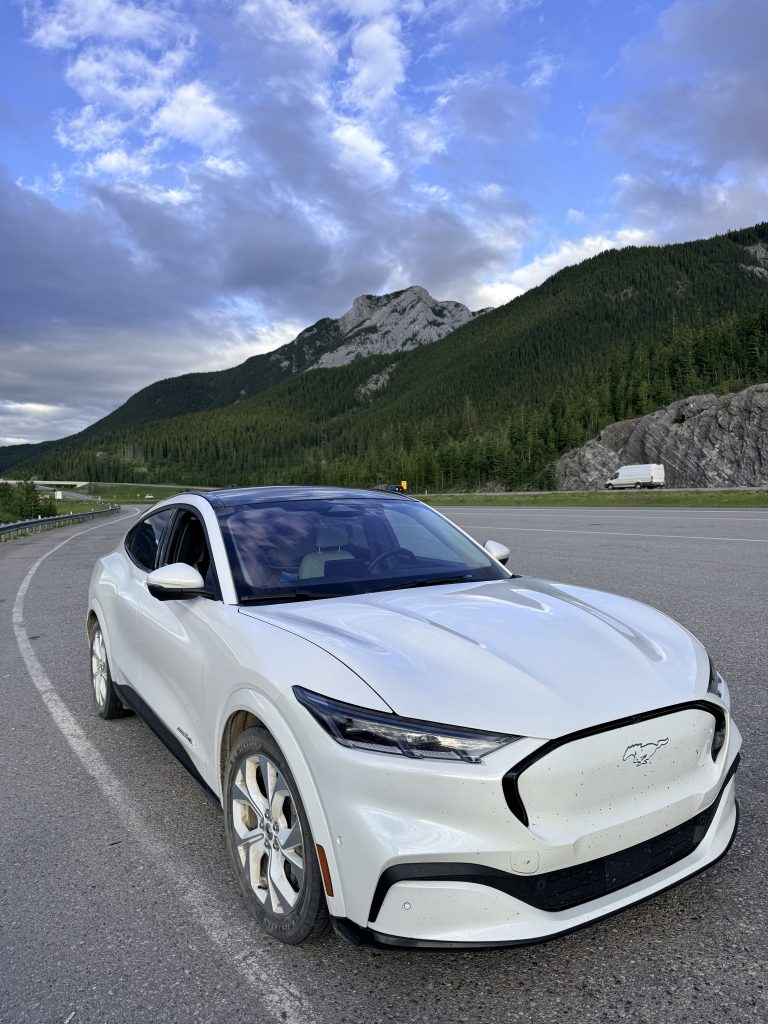
My Canada EV road trip took me from Québec to Vancouver before I eventually made my way back east. If you’re more interested in the actual route, stops and destinations, you can follow my full Canada road trip itinerary from Québec to Vancouver.
Before leaving, I expected charging to be the hardest part. It wasn’t.
The real challenge of driving across Canada in an EV was learning how to balance range, charging infrastructure, weather, elevation and remote highways.
After 12,941 kilometres—but hey, who’s counting?! These are the 10 biggest lessons I learned from taking a road trip across Canada in an EV, and what I would tell anyone considering doing the same.
1. Your EV’s Estimated Range Is Only a Starting Point
One of the first things I learned was to stop treating the estimated range on my dashboard as a promise. Your actual range can change constantly depending on your driving speed, elevation, wind, outside temperature, use of heating or air conditioning, vehicle weight, and even your recent driving habits.
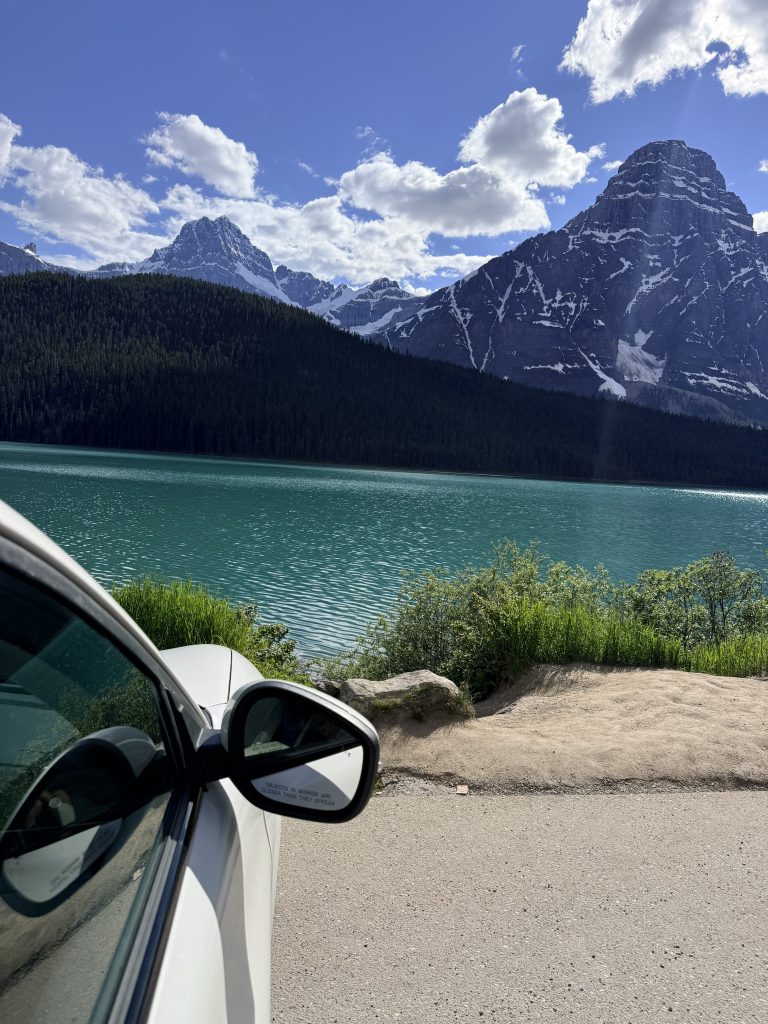
This became especially noticeable in Northern Ontario and once I reached the Canadian Rockies. Long climbs toward the mountains required significantly more energy, while some downhill sections gave part of it back through regenerative braking.
Eventually, I stopped watching the kilometre estimate and focused more on where I was driving next. A 150-km buffer feels very different in a city than on a remote highway with one charger.
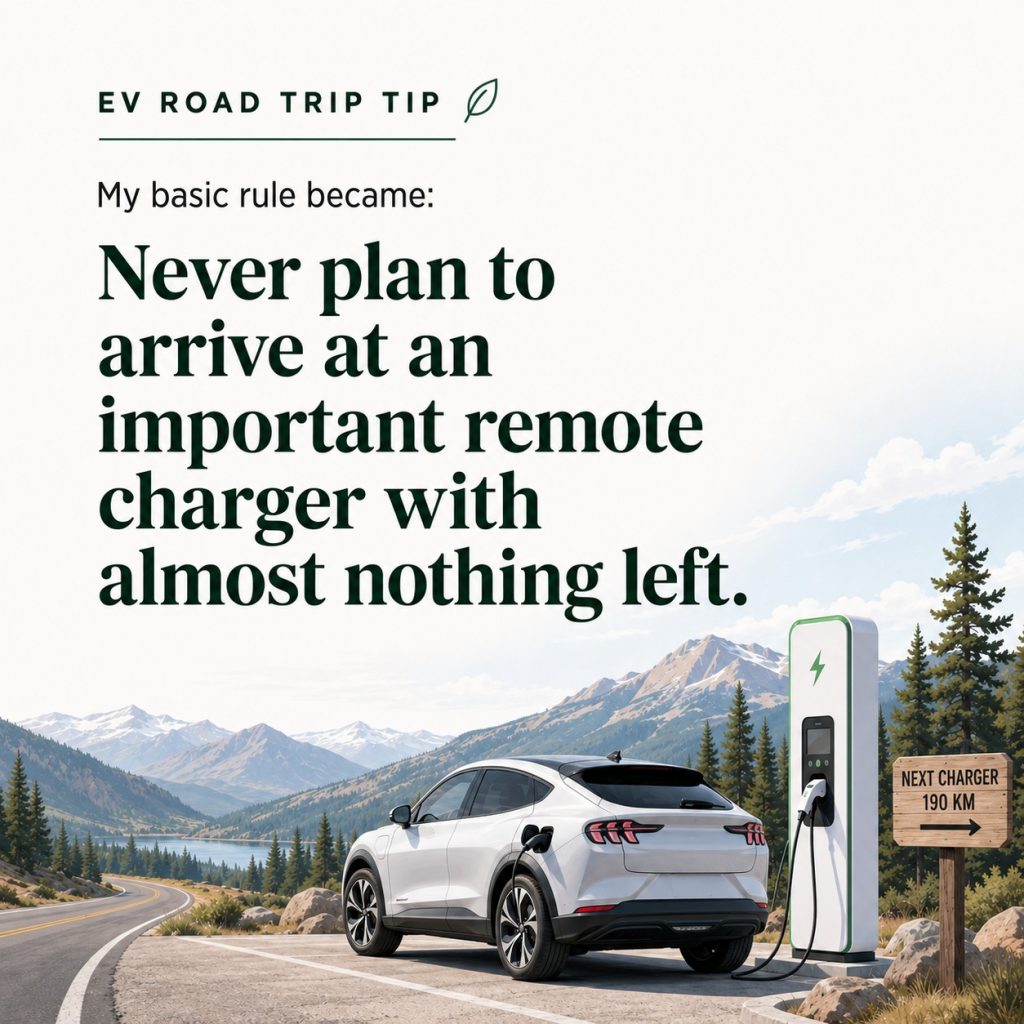
Use Google Maps’ Arrival Battery Estimate
Pro Tip: If you use Google Maps with an Android in a Mach-E, it can estimate your battery percentage at arrival. After testing it across the Rockies and Icefields Parkway, I found it extremely reliable—about 98% accurate in my experience. I still kept a buffer, but it became one of my most trusted planning tools.
2. Download Your Apps Before Driving Across Canada in an EV
There isn’t one universal network for EV charging across Canada, so I kept several apps ready as I crossed the country:
- Québec – Circuit électrique
- Ontario – Ivy
- Multiple provinces – FLO
- Multiple provinces – ChargePoint
- British Columbia – BC Hydro EV
- Across Canada – Tesla, especially with my NACS adapter
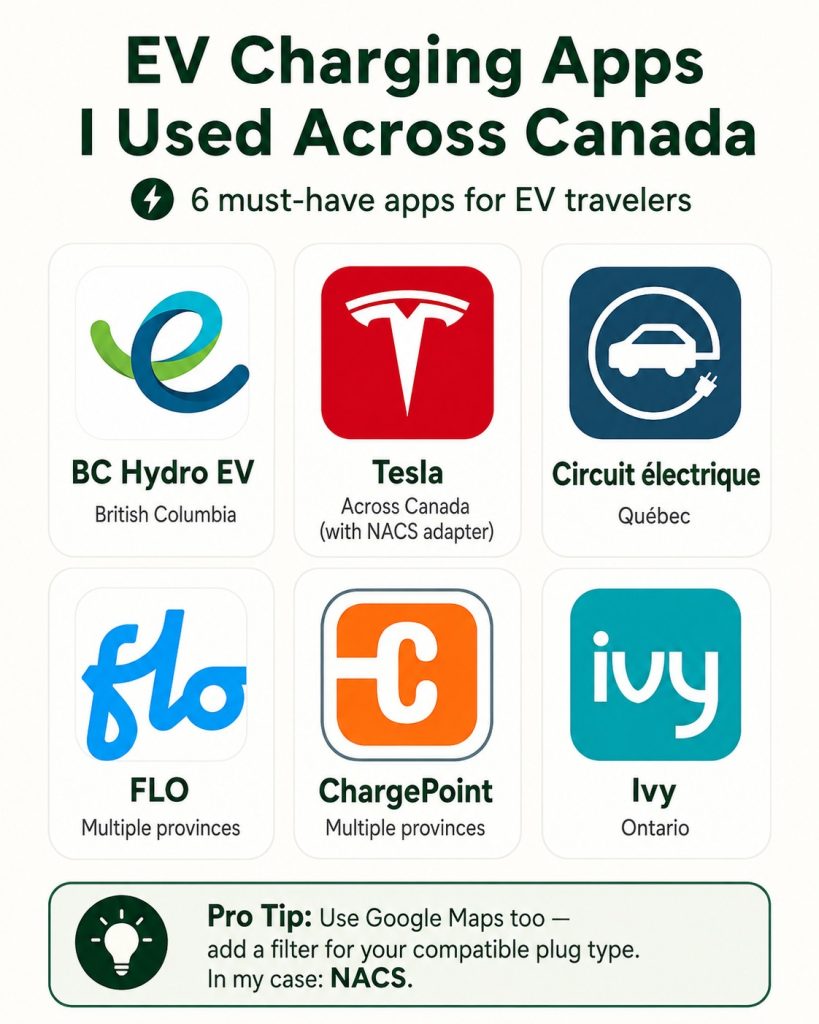
I didn’t use every app everywhere, but having several options made charging much easier when one network wasn’t available.
Set everything up before you leave. Create your accounts, add payment details, and make sure each app works—you don’t want to be troubleshooting with 12% battery and barely any cell service.
Pro Tip: Use Google Maps to find chargers along your route, but make sure you add a filter for the plug type compatible with your vehicle. In my case, that meant selecting NACS so I wasn’t wasting time driving to chargers my Mach-E couldn’t use.
When your phone handles navigation and charging apps, keeping it powered matters too; you’ll find my charging gear in my travel tech essentials guide.
3. Tesla Superchargers Were the Game Changer
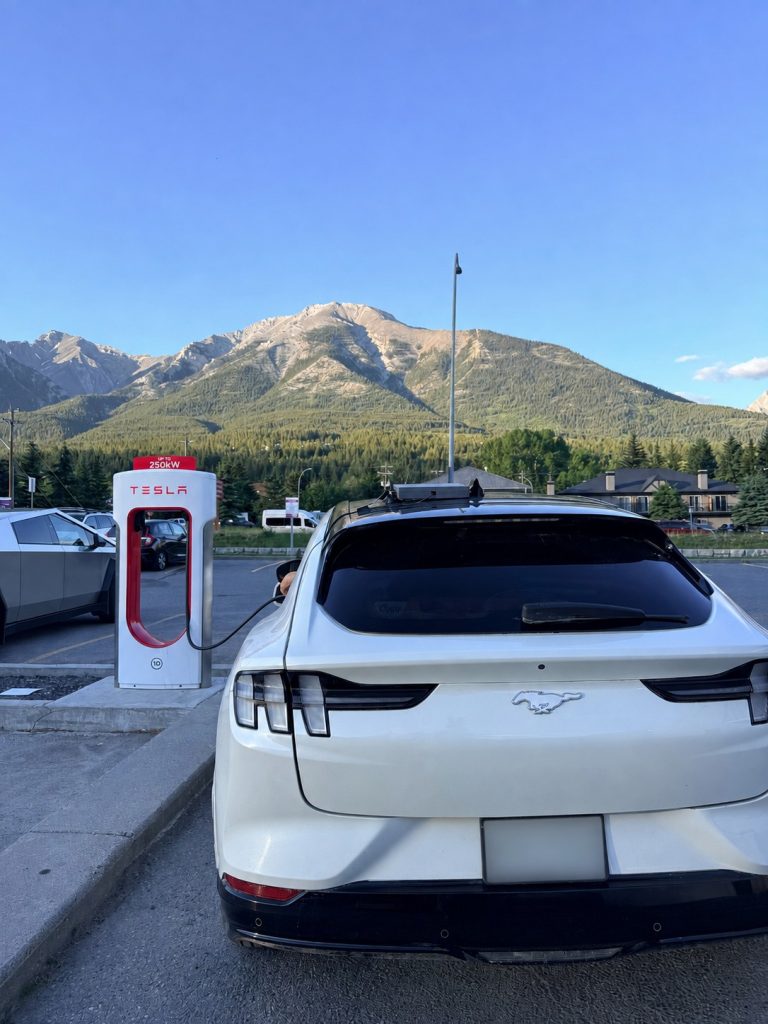
Access to compatible Tesla Superchargers with my NACS adapter completely changed the trip. For my Mustang Mach-E, Tesla became my preferred option whenever available because of the speed, reliability and multiple charging stalls. It saved time and removed a lot of the uncertainty that comes with relying on a single remote charger.
One thing to know: Tesla cables are short and designed around Tesla charging-port locations. With my Mach-E, I sometimes had to park sideways or position the car creatively so the cable could reach—but I always managed to make it work.
Pro Tip: Set your compatible plug type in both Tesla and Google Maps. For my Mach-E, selecting NACS filtered out Superchargers I couldn’t use.
4. Use Google Maps to Confirm Charger Compatibility
Google Maps became one of my most useful tools for finding chargers along the route and checking whether they were compatible with my Mach-E. Once your EV and plug type are set up correctly, it becomes much easier to avoid wasting time on chargers your vehicle can’t use.
Know your connector, set your filters, and let Google Maps narrow the options for you.
5. EV Charging Varies Across Canada
Charging infrastructure changes a lot from province to province. Québec felt easy with frequent options, while remote parts of Northern Ontario and the Prairies required more planning and fewer backup choices.
In Alberta and British Columbia, elevation added another factor, especially through the Rockies where climbs affected range more noticeably.
The key lesson: don’t treat Canada as one charging environment. Plan region by region and know your next reliable option.
6. Charging Breaks Can Actually Improve the Trip
Charging made the trip slower, but not necessarily worse. It naturally forced me to stop, stretch, eat, walk around and reset—which often left me less tired on long driving days.
I also started choosing chargers near waterfronts, cafés, grocery stores or small towns, which sometimes led me to places I would have otherwise driven past.
A charging stop can feel like wasted time—or simply become part of the road trip.
7. Don’t Rely on Hotel EV Charging
I initially thought hotel charging would be one of the easiest ways to start each day with a full battery. In Québec, that worked fairly well. But once I traveled farther west, it became much less reliable.
Hotels with EV chargers were harder to find, and when they did have them, I often ran into chargers that were malfunctioning, occupied or simply too limited for the number of EV drivers using them. Eventually, I stopped planning around hotel charging altogether and relied on the public fast-charging network instead.
If your accommodation happens to have a working charger, great—treat it as a bonus. Just don’t make it something your road-trip plan depends on.
8. Carry More Than One Charging Solution
My Mustang Mach-E setup gave me several ways to charge, but that flexibility existed because I came prepared. Here’s the charging gear and equipment I brought with me to give myself as many options as possible along the way:
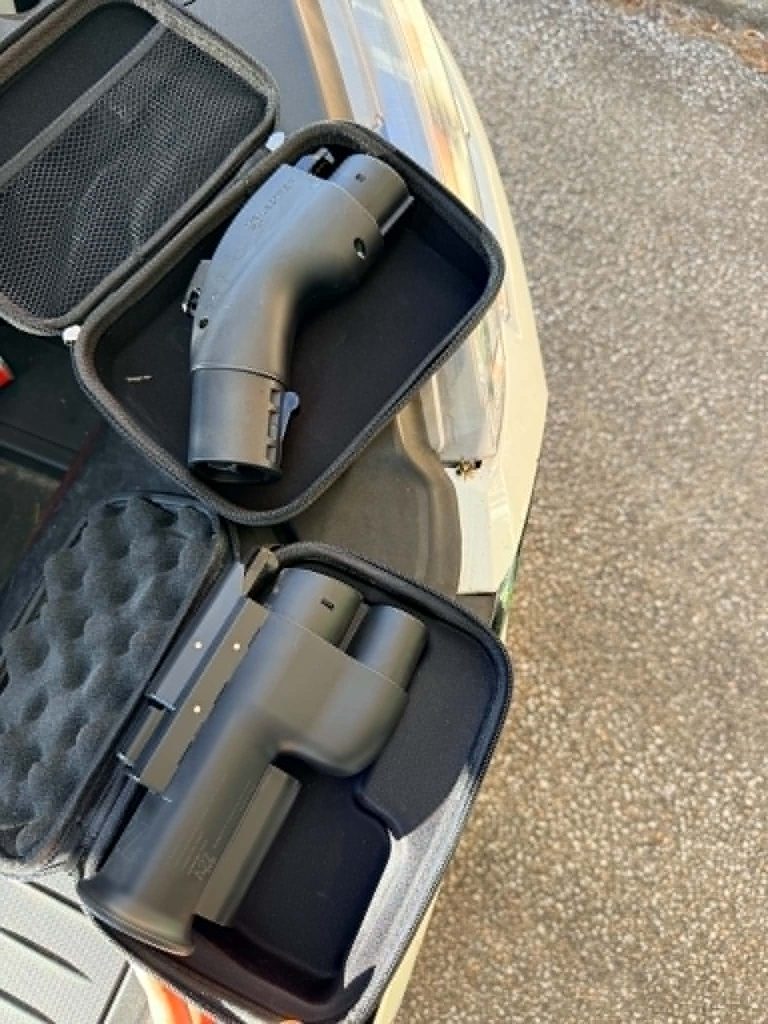
- A NACS-to-CCS1 adapter for compatible Tesla Superchargers
- A NACS-to-J1772 adapter for Tesla Destination Chargers
- My Ford mobile power cord
- A heavy-duty extension cord
- Several charging apps already configured
The NACS-to-CCS1 adapter became one of the most valuable pieces of equipment I carried because it opened compatible Tesla Superchargers to my Mach-E.
This setup was specific to my Mach-E, so your charging gear may look completely different depending on your EV. For me, the goal was simply to have a few different ways to charge instead of relying on one option. Most of the time, that flexibility was just convenient, but on the more remote stretches, it gave me a lot more peace of mind.
9. Some EV Perks Made the Road Trip Better
Most people focus on the compromises of driving an EV—range, charging and planning—but there were plenty of moments when having my Mach-E actually made the trip better.
Smooth, Quiet Driving
The Mach-E was incredibly smooth to drive, with instant acceleration and no traditional gear changes. It was also so quiet, especially at campsites and scenic stops.
Climate Control While Parked
This was one of my favourite perks. I could keep the air conditioning running while waiting for ferries during heat waves or while sleeping in the car without idling a gasoline engine.
Extra Storage
The frunk became surprisingly useful for separating camping gear, groceries and other road-trip essentials.
Charging Stations Became Social
I also made unexpected connections at charging stations. Waiting around naturally led to conversations about cars, routes and charging tips with other EV drivers.
Regenerative Braking in the Mountains
Climbing through the Rockies used more energy, but watching regenerative braking recover some of it on long descents was extremely satisfying.
Lower Energy Costs
For my entire Québec-to-Vancouver-and-back trip, I spent about $1,900 CAD on charging, including extra power used for climate control while camping.
Less Routine Maintenance
There are still maintenance costs with an EV, but no engine oil changes was one less thing to think about on such a long trip.
Lower Tailpipe Emissions
An EV road trip isn’t impact-free, but I appreciated traveling thousands of kilometres without burning gasoline directly or producing tailpipe emissions along the way.
Before leaving, I thought the EV would mostly be something I had to manage. By the end, I realized there were plenty of reasons I was genuinely happy to be driving one.
10. An EV Road Trip Forces You to Slow Down—and That’s Not a Bad Thing
Driving an EV made me pay more attention to distance, infrastructure, weather and elevation—and sometimes simply slow down.
That slower rhythm wasn’t a bad thing. It taught me to see the road as part of the experience, a mindset I later carried into drives like the Sea to Sky Highway from Vancouver to Whistler, where slowing down and enjoying the stops was the whole point. Charging breaks gave me time to stretch, look around, talk to other travelers and discover places I might otherwise have driven past.
The fastest journey was never really the point.
FAQ
Would I Drive Across Canada in an EV Again?
Absolutely.
Once I had my charging apps, adapters and backup options figured out, the trip became much easier than I expected. I would still plan more carefully through remote areas and use compatible Tesla Superchargers whenever possible, but I would do the trip again without hesitation.
The biggest lesson was simple: don’t expect an EV road trip to behave like a gas-powered one. Once I stopped trying to force the same rhythm, I enjoyed it much more.
Is Driving Across Canada in an EV Worth It?
For me, yes.
Driving across Canada in an EV made me slow down, notice more and experience places I might otherwise have driven past. It required more planning, but it also gave the trip a rhythm I genuinely enjoyed.
After 12,941 kilometres, I didn’t come away thinking, I survived crossing Canada in an EV. I came away thinking, I’d do it again.
Prepare your charging setup, keep a backup option in mind, and then stop staring at the battery percentage long enough to enjoy the road.
Canada is far too beautiful to rush through.
Continue Exploring Vancouver
If Vancouver is your final destination, start with my 25 best things to do in Vancouver for the experiences, neighbourhoods and day trips I enjoyed after arriving on the West Coast.
Only have a few days in the city? My three-day Vancouver itinerary turns those ideas into a realistic day-by-day plan.